
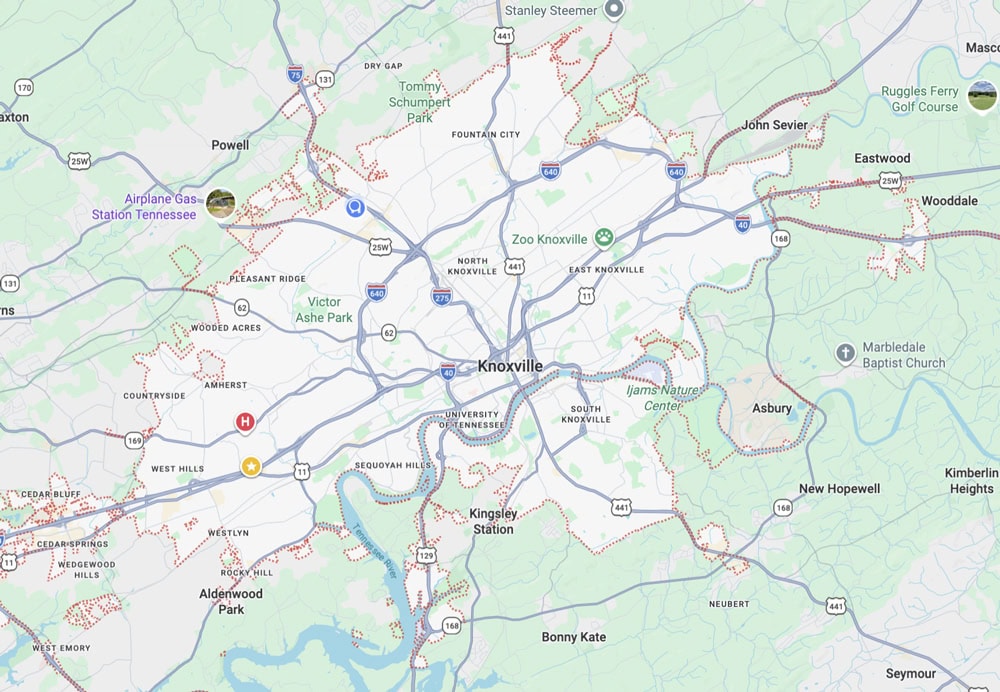
If you run a business that travels to customers—HVAC, roofing, plumbing, cleaning, landscaping, mobile services, even agencies that serve multiple cities—Google calls you a Service Area Business (SAB). Service Area Business SEO has its own rules.
You’ve probably asked questions like:
- “Can I rank in Knoxville if I don’t have a storefront?”
- “Should I show my address or hide it?”
- “Do I need pages for Farragut, Powell, Hardin Valley, and Fountain City?”
- “Why am I invisible in Google Maps even though my website looks good?”
This playbook breaks down the most reliable strategy to rank a service-area business in Knoxville and surrounding areas—without risky tactics that lead to suspensions or ranking volatility.
What Is a Service Area Business (SAB)?
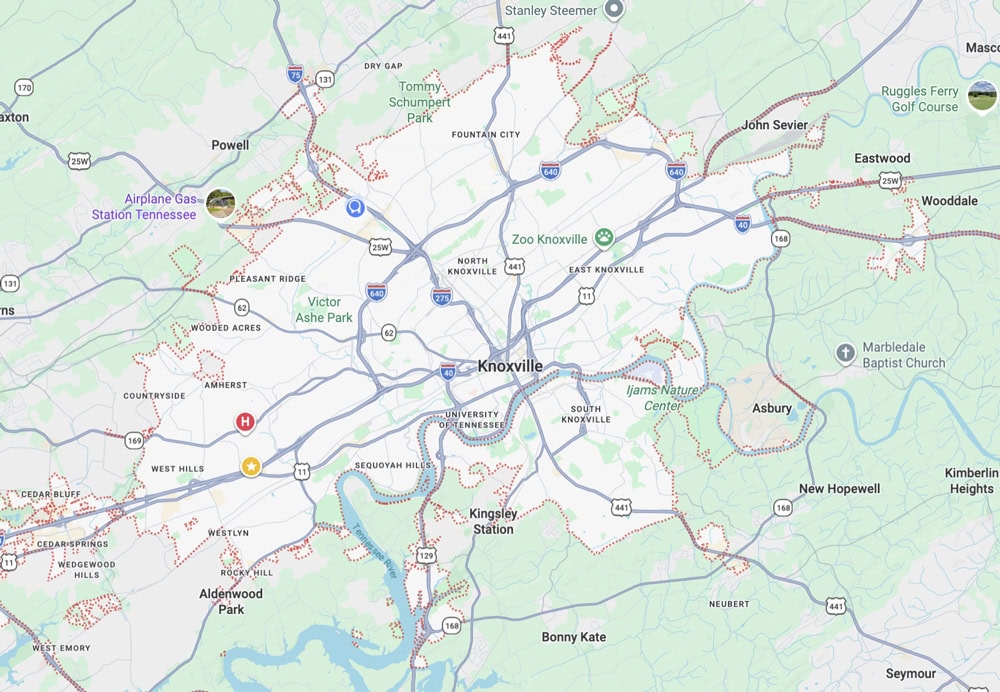
A service-area business provides services at the customer’s location. You might serve:
- Knoxville
- Farragut
- Hardin Valley
- Powell
- Fountain City
- Cedar Bluff / Bearden
- Maryville, Oak Ridge, Lenoir City, Loudon (if applicable)
You can still rank locally in Google Maps, but Google needs clarity on:
- what you do
- where you do it
- why you’re trusted
The Most Important SAB Rule: Stay Compliant
A lot of SAB rankings fail because the Google Business Profile is set up incorrectly.
Should you show your address?
If you don’t have a staffed office where customers can visit during posted hours, you generally should not present it as a public storefront location.
Most SABs should:
- set a service area
- hide the address (if they don’t serve customers at that address)
- stay consistent everywhere online
Why it matters: compliance issues can lead to suspensions or long-term ranking instability.
Service Area Business SEO = Relevance + Prominence + Conversion (Distance is Harder)
Distance is tough for SABs because you’re often not “closest.”
So you win by becoming:
- the most relevant
- the most trusted
- the most clicked and chosen
That comes from GBP optimization + reviews + proof + authority + a website that supports your service area.
Step 1: Google Business Profile Setup for SABs (Knoxville Edition)
1) Categories are everything
Pick the most accurate primary category based on your main revenue service.
Then add 2–4 supporting categories that truly match what you do.
2) Service areas: don’t overdo it
You don’t need to add every city in Tennessee.
Pick your real service areas and keep it tight:
- Knoxville (primary)
- 4–10 surrounding areas you actively serve and can prove
3) Services: fill them out like a menu
List your real services with clear names. Add short descriptions where possible.
4) Photos and proof: weekly activity wins
For SABs, trust is built visually:
- trucks / team
- job site photos
- before-and-after
- “in-progress” shots
- completed work
- short videos
This isn’t just “marketing.” It’s a local trust engine.
5) Posts: 2 per week minimum
Post consistently:
- tips
- recent projects
- seasonal reminders
- promotions (when relevant)
- FAQs
If you want faster momentum, increase to 3–4/week for the first 60 days.
Step 2: The Website Structure That Helps SABs Rank
If your website is generic, your Maps visibility suffers.
The winning SAB structure
You want a clean hierarchy:
- Homepage (brand + primary service)
- Core service pages (one per main service)
- Knoxville hub page (if not already implied)
- Service-area / location pages (only if unique and valuable)
- Blog content that supports all of the above
What should your service pages include?
At minimum:
- clear service overview
- “who it’s for”
- process
- proof (photos, reviews, results)
- FAQ section
- strong CTA (call / book / request quote)
If you’ve ever wondered why your competitors outrank you with “uglier” websites, it’s usually because their pages are built around search intent + proof + internal links.
Step 3: Location Pages for SABs (Do This Safely)
Location pages work when they are:
- useful
- unique
- proof-backed
They fail when they are:
- copy/paste city swaps
- thin pages with no real intent
Start with the “Hub + Spokes” model
- Knoxville hub page (strong, comprehensive)
- Then 3–5 supporting areas (Farragut, Powell, Hardin Valley, Fountain City, etc.)
Minimum content requirements for SAB location pages
Each location page should have:
- a local hook (not generic)
- service breakdown
- local proof (projects, photos, testimonials)
- FAQs tailored to that area
- internal links to core service pages + related blog posts
- CTA
If you can’t make a location page unique, don’t publish it yet.
Step 4: Reviews for SABs (The Ranking Accelerator)
For SABs, reviews are the fastest “prominence” lever you can pull.
Review strategy that wins in Knoxville
- Ask every happy customer within 24–72 hours
- Follow up once 48 hours later
- Respond to every review within 48 hours
- Aim for steady monthly velocity (not bursts)
Review request script (copy/paste)
“Hey [Name] — quick favor. If you were happy with our work, would you leave us a Google review? It helps other Knoxville-area customers find a trusted [service]. Here’s the link: [LINK]”
Review responses that convert
Keep it human, specific, and professional:
“Thanks, [Name]! We’re glad we could help with [service]. We appreciate the opportunity to serve you in the Knoxville area.”
Step 5: Citations + Consistency (Don’t Skip This)
SABs often get messy citations because of:
- address changes
- phone number changes
- rebrands
- duplicates across directories
Your job:
- keep NAP consistent
- fix duplicates
- prioritize major platforms first (Google, Apple Maps, Bing, Facebook, Yelp, LinkedIn)
Citations rarely “rocket” rankings alone, but messy citations can absolutely hold you back.
Step 6: Local Links + Community Proof (The Differentiator)
When two SABs have similar reviews and similar websites, links and authority often decide who wins.
Knoxville-friendly link ideas
- sponsorships (local events, teams, fundraisers)
- vendor/partner pages
- client case studies (ask clients to link back)
- chamber/business associations
- local PR features
- community involvement pages
One solid local link from a reputable Knoxville organization can move the needle more than dozens of weak directory links.
The 60-Day SAB SEO Sprint (Action Plan)
If you want a simple plan that works:
Days 1–7
- Audit GBP: categories, services, hours, service area
- Add 20–30 real photos + 2 videos
- Create review request process + link
Days 8–30
- 2 GBP posts/week (minimum)
- Ask for reviews consistently
- Update citations on major platforms
- Improve core service pages (proof + FAQs + CTAs)
Days 31–60
- Publish 2–4 supporting blog posts (like the ones in this cluster)
- Build 1–2 quality local links
- Add 1–2 unique location pages (only if you have proof)
Common Service Area Business SEO Mistakes (That Kill Rankings)
- using a non-compliant address setup
- stuffing the business name with keywords
- choosing the wrong primary category
- having thin service pages with no proof
- creating 20 copy/paste city pages
- no review system (only “sometimes” asking)
- no internal linking strategy
Request a Free Local SEO Audit
Want a clear, prioritized plan to rank your service-area business in Google Maps across Knoxville and surrounding areas?
Talk to G Squared Studios about Knoxville SEO + Web Design