
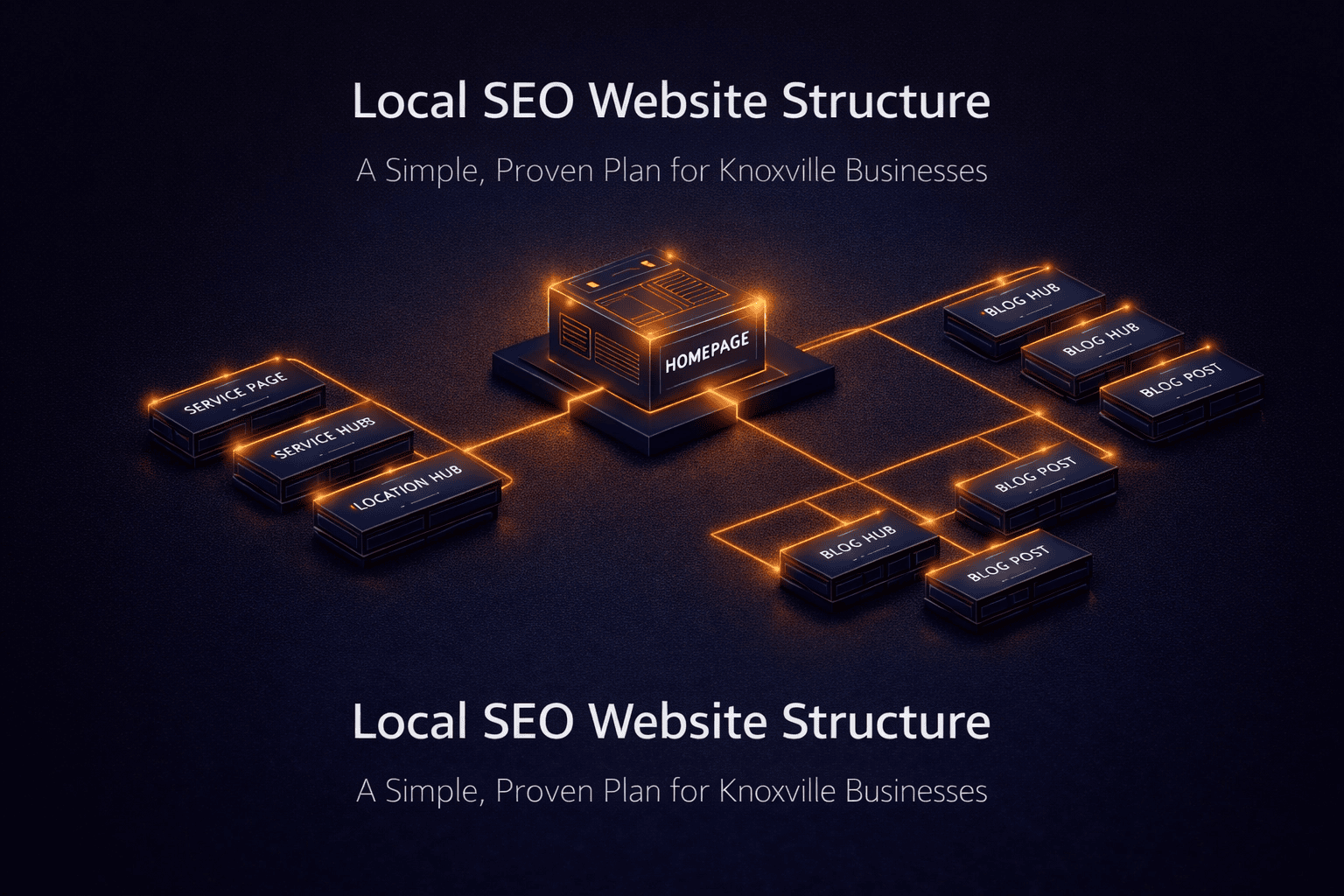
If your website isn’t bringing in traffic or leads, the problem often isn’t “SEO” in a general sense—it’s structure. Most local business websites are built for looks, not for ranking. And while a beautiful site is important, Google can’t rank what it can’t understand.
Local businesses in Knoxville tend to share a handful of structural problems:
- Everything is crammed onto the homepage, diluting relevance for every keyword
- Service pages are thin, vague, or missing entirely
- Location pages are copy/paste city swaps with no unique value
- Blog posts exist in isolation and never connect to money pages
- Internal linking is random—or nonexistent
Google consistently ranks well-organized sites higher because they’re easier to crawl, easier to understand, and more likely to satisfy what a searcher is actually looking for.
This post gives you a simple, proven structure for building a website that ranks in Knoxville and converts visitors into real calls and leads. If you’ve recently gone through a website redesign, this is the structure you should be building toward.
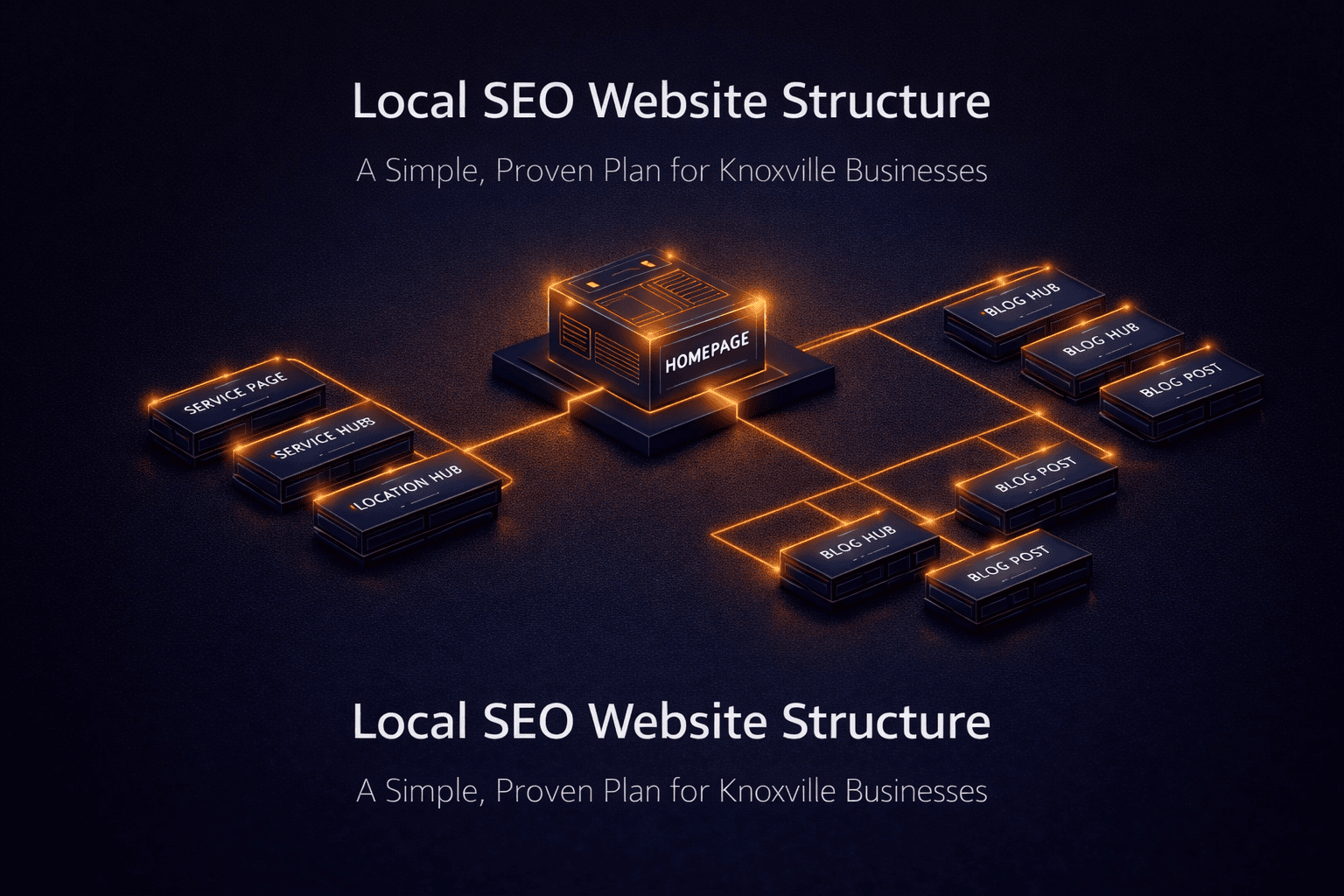
The Goal of a Strong Local SEO Website Structure
A well-built local site structure does two jobs simultaneously:
- Tells Google exactly what you do and where you do it—so it can rank you for the right searches
- Makes it easy for visitors to take action—so traffic actually turns into leads
Think of your website like a map. Google needs a clear hierarchy to understand how pages relate to each other. Customers need a clear, obvious next step at every point in their journey. A site that nails both will consistently outperform competitors who only focus on one.
The Ideal Local SEO Site Map (Simple Version)
For most Knoxville service businesses, the optimal structure looks like this:
- Homepage
- Core service pages (one dedicated page per major service)
- Knoxville hub page (optional but powerful in competitive markets)
- Supporting location pages (only when unique and proof-backed)
- Blog content clusters (supporting your service pages with topical authority)
- Trust pages: About, Reviews/Testimonials, Portfolio/Case Studies, Contact
Let’s break down what each of these needs to accomplish.
1. Homepage: Set the Stage, Then Get Out of the Way
Your homepage has one job: communicate what you do, establish trust, and point visitors toward the right next page—fast. Most visitors will decide within a few seconds whether they’re in the right place.
Your homepage should:
- Clearly state what you do within the first 3 seconds of landing
- Include a strong, above-the-fold CTA (call, book, or request a quote)
- Highlight your core services with links to individual service pages
- Include trust proof: reviews, awards, certifications, and real results
- Route visitors to the right next page for their specific need
What Your Homepage Should NOT Do
Your homepage should not try to rank for every service and every city all on one page. That leads to weak keyword relevance, thin content sections, and poor conversions across the board.
Best practice: Let the homepage introduce and route. Let your service pages do the ranking.
2. Core Service Pages: Your Ranking Engine
If you want to rank for high-intent keywords—the searches that bring in real buyers—you need one strong, dedicated page per core service. This is the foundation of any serious local SEO strategy.
For a web design and SEO agency, that might look like:
- Web Design
- SEO Services
- Local SEO
- WordPress Maintenance
- Branding / Logo Design
For a home services business, it might look like:
- HVAC Repair
- HVAC Installation
- Heat Pump Repair
- AC Repair
- Duct Cleaning
What Must Be on Every Service Page
- A clear definition of the service and who it’s for
- Benefits and outcomes the customer can expect
- Your process (what happens after someone contacts you?)
- Proof: reviews, case study snippets, or real before/after results
- FAQs that answer genuine buyer questions (huge for SEO and conversions)
- A strong CTA repeated multiple times throughout the page
Word count tip: For competitive services, aim for 900–1,500+ words of genuinely helpful content. Thin service pages rarely rank against established competitors
3. Knoxville Hub Page: Your Local Authority Anchor
A Knoxville-specific hub page is especially valuable when:
- Your service category is competitive in the local market
- You serve multiple nearby areas (Farragut, Powell, Hardin Valley, etc.)
- You want stronger “Knoxville relevance” signals across your entire site
This page targets queries like “[service] Knoxville,” “[business type] Knoxville,” and “near me”-style intent—while also serving as the internal link hub that supports all your other local pages.
What Goes on the Hub Page
- Overview of your services in the Knoxville market
- Key service areas and neighborhoods you cover
- Local proof: projects, client reviews, local partnerships
- Internal links to all core service pages
- Links to your strongest blog content
Think of it as your “local authority page”—the page that tells Google you’re the real deal in this specific market.
4. Location Pages: Use Strategically, Not as Doorways
Location pages can be powerful—or they can actively hurt you. The difference is whether they’re genuinely useful or just thin keyword-stuffed variations of your main pages.
Location Pages That Work
- Unique content written for that specific area
- Local proof: photos, reviews, or projects from that area
- Genuine FAQs tailored to that community
- Strong CTAs and internal links to core service pages
Location Pages That Fail (and Can Hurt You)
- Copy/paste pages with only the city name swapped
- Thin pages with no unique value beyond the location keyword
- Pages created purely to rank for city variations, with no real content
The safe and effective model is a hub-and-spoke approach:
- Knoxville hub page (center of your local structure)
- 3–5 nearby area pages (Farragut, Powell, Hardin Valley, Fountain City, etc.)
Each location page should have a local hook, area-specific FAQs, relevant proof, and clear internal links back to your service pages. If a page can’t meet that bar, don’t publish it.
5. Blog Content Clusters: Building Topical Authority
Most business blogs fail for one simple reason: the posts are random and disconnected. There’s no strategy tying them together, and none of them support the service pages that actually drive revenue.
The right approach is a cluster model:
- 1 pillar post (a comprehensive guide covering the broad topic)
- 4–8 supporting posts (diving deeper into specific subtopics)
- Every post links to your core service pages and to each other
This is how you build topical authority—and it’s how Google learns that your site is the go-to resource for a given subject in your area.
Example Cluster: Local SEO for a Knoxville Agency
- Knoxville Local SEO Guide (pillar)
- Google Business Profile Optimization Checklist
- How to Get More Google Reviews (and Use Them for SEO)
- Citation Building Strategy for Local Businesses
- Local Landing Pages: What Works and What Doesn’t
- Service Area Business SEO Playbook
Every one of those posts supports the SEO services page and reinforces the local hub pages. That’s how you turn a blog into a lead generation asset rather than a content graveyard.
6. Trust Pages: The Conversion Multiplier
Trust pages don’t always rank for high-volume keywords, but they convert traffic that’s already on your site. These pages answer the question every buyer eventually asks: “Can I trust these people?”
- About: Your story, your credentials, your ‘why.’ Humanizes the business and builds connection.
- Reviews / Testimonials: Third-party proof that you do what you say. Essential for buyers in the consideration stage.
- Portfolio / Case Studies: Show, don’t just tell. Real results build confidence fast.
- Contact: Frictionless, fast, and obvious. Every extra step you require loses leads.
If your site is missing a portfolio or case study page, adding one is often one of the quickest conversion wins available.
Internal Linking: The Secret Weapon Most Sites Ignore
Internal links do more than help users navigate. They tell Google which pages are most important, how topics relate to each other, and where to focus crawl budget. For local SEO in Knoxville, a strong internal linking structure can be the difference between ranking on page one and being buried on page three.
Simple Internal Linking Rules to Follow
Every blog post should link to:
- 1 relevant service page (with descriptive anchor text)
- 1 related blog post (to keep readers engaged and build topical depth)
- 1 conversion page (contact form, audit request, or booking link)
Every service page should link to:
- 2–4 supporting blog posts that go deeper on related topics
- The contact page (always)
Your hub and location pages should link to:
- All core service pages
- Your strongest local SEO blog posts
Anchor Text Tips
Keep anchor text natural and descriptive. Good examples:
- “Knoxville local SEO”
- “SEO services in Knoxville”
- “web design Knoxville”
- “WordPress maintenance”
Avoid repeating the exact same anchor text phrase over and over. Variation looks natural to Google and covers more keyword surface area.
Example: A “Perfect” Local SEO Site Map (Agency Version)
Here’s what a well-structured site looks like in practice for a Knoxville web design and SEO agency:
- Home
- Web Design
- SEO Services
- Local SEO
- WordPress Maintenance
- Knoxville Web Design Hub
- Knoxville SEO Hub
- Service Areas: Farragut / Powell / Hardin Valley / Fountain City (unique content only)
- Blog (organized into topic clusters)
- Portfolio / Case Studies
- Reviews
- About
- Contact
This structure makes it crystal clear to Google what the business does and where it does it—while making it equally easy for potential clients to find what they need and take the next step. You can see this in action on the G Squared Studios website.
Related Reading from the G Squared Studios Blog
These resources from our Knoxville digital marketing blog go deeper on the topics covered in this post:
- Website Redesign Checklist (2026): 7 Signs It’s Time + Step-by-Step Plan
- Local SEO Services — Knoxville
- Knoxville Web Design Services
- WordPress Website Development — Knoxville
- Request a Free Website + SEO Audit
Want a Site Structure That Actually Ranks in Knoxville?
If this post revealed that your current site is missing key structural pieces, you’re not alone—and a clear plan is closer than you think.
G Squared Studios is a Knoxville-based web design and SEO agency with 20+ years of experience building sites that rank on Google and convert visitors into real leads. Every project is handled personally by our team—no outsourcing, no guesswork.
We’ll map out your ideal page architecture and internal linking plan in a single, focused audit—so you know exactly what to build and why.