

A lot of local business websites have the same problem:
They look fine… but they don’t produce leads.
And usually, it’s not because of “SEO.” It’s because the service pages don’t answer the real questions a buyer has when they’re ready to hire.
If you want more calls, more form fills, and better rankings, your service pages need two things:
- Search intent match (so Google knows you’re relevant)
- Conversion structure (so humans take action)
This post gives you a simple, proven service page copy formula you can use for almost any local business in Knoxville (or anywhere else).
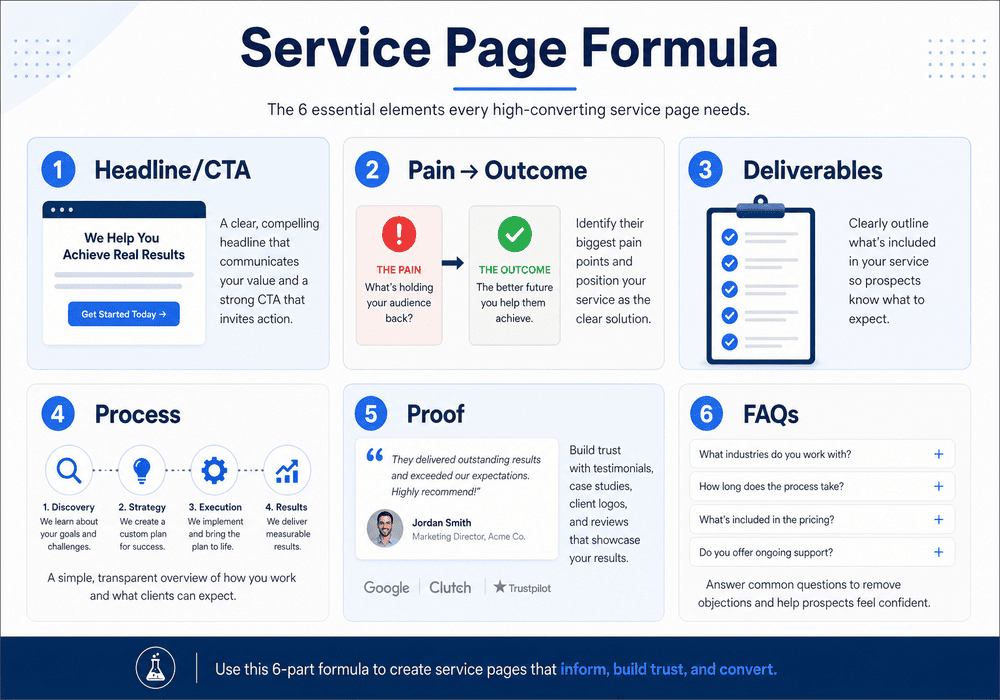
Why Service Pages Fail (Even When They Look Good)
Most service pages fail because they’re:
- too short and generic
- focused on the business, not the customer
- missing trust proof
- missing clear next steps
- not written to match “buyer intent” keywords
A buyer searching “HVAC repair Knoxville” or “web design Knoxville” isn’t looking for a history lesson. They want:
- “Can you solve my problem?”
- “Are you legit?”
- “How much will it cost?”
- “How fast can you help?”
- “What do I do next?”
Your service page should answer those questions naturally.
The Service Page Copywriting Formula (Use This Template)
1) Above-the-Fold “3-Second Clarity”
This is the top section of your page. It must instantly communicate:
- what you do
- who it’s for
- where you do it
- what action to take
Example headline formula:
[Service] in [Location] that helps you [outcome] — without [pain]
Examples:
- “SEO Services in Knoxville that drive real leads — not vanity rankings.”
- “HVAC Repair in Knoxville with fast scheduling and honest pricing.”
Above-the-fold checklist:
- Clear H1 (service + location)
- One-sentence value proposition
- Primary CTA button (Call / Book / Request Quote)
- Trust proof (rating, # of reviews, badges, years, etc.)
2) The “Problem → Outcome” Section
Explain what’s going wrong and what life looks like after it’s fixed.
What to include:
- 3–5 common pain points (specific)
- 3–5 outcomes (benefits)
Example (agency SEO):
Pain points:
- “You’re invisible in Google Maps.”
- “Your site gets traffic but no calls.”
- “You’re paying for SEO but don’t know what’s happening.”
Outcomes:
- “Higher visibility for service + city searches.”
- “More qualified leads.”
- “Clear reporting and a predictable plan.”
3) Services Included (Make It Concrete)
A common conversion killer is vague service descriptions.
Instead of:
“We provide high-quality web design.”
Use:
- bullet lists with clear deliverables
- short descriptions of what’s included
Example (web design):
- Custom homepage design (conversion layout)
- Service page buildouts (SEO-ready)
- Mobile-first optimization
- Speed improvements
- Contact/lead capture setup
- Analytics and tracking
This section reduces uncertainty and increases trust.
4) Your Process (This Builds Confidence Fast)
Buyers want to know what happens after they contact you.
Process section template:
- Quick call + goals
- Audit + recommendations
- Build/execute
- Review + launch
- Ongoing support (optional)
Even if your process is flexible, write it down. It’s a trust multiplier.
5) Proof Section (The Ranking + Conversion Unlock)
Proof is what turns “maybe” into “yes.”
Include at least 2 of these:
- Testimonials (best if they mention results)
- Case studies / mini case studies
- Before/after metrics (speed, rankings, leads)
- Project screenshots / photos
- Partner logos / certifications
- “Trusted by…” statements
Pro tip: If you can only add one thing to a service page, add proof.
6) Pricing Guidance (Even if it’s a range)
You don’t have to list exact prices, but giving a range reduces friction.
Options:
- “Starting at…”
- “Typical projects range from…”
- “Packages available…”
This prevents time-wasters and builds trust with serious buyers.
7) FAQ Section (SEO + Conversions in One)
FAQs help you rank for long-tail searches and remove objections.
Aim for 6–10 FAQs per service page.
Examples (web design):
- How much does a website cost in Knoxville?
- How long does a website take to build?
- Will my website be SEO-friendly?
- Can you redesign my existing site?
- Do you offer hosting and maintenance?
Examples (SEO):
- How long does SEO take?
- Can you help me rank in Google Maps?
- Do you provide monthly reports?
- What’s included in your SEO packages?
8) “Why Choose Us” Section (Differentiation)
Most pages say “We’re the best.” That doesn’t mean anything.
Use specific differentiators:
- strategy-first approach
- transparent deliverables
- fast turnaround
- local expertise
- proven process
- industry specialization
Make it measurable when possible:
- response times
- turnaround times
- number of projects
- local focus
9) Strong CTA Blocks (Don’t Be Shy)
A service page should have a CTA:
- above the fold
- mid-page
- at the end
CTA example:
“Request a Free Audit”
“We’ll review your website, your local visibility, and give you a prioritized plan.”
Form tips:
- keep it short (name, email, phone, message)
- offer a clear next step (“We’ll respond within 1 business day”)
The “Perfect” Local Service Page Outline (Copy/Paste)
Use this as a blueprint:
- H1 + value proposition + CTA
- Quick trust proof bar (reviews, badges)
- Pain points + outcomes
- What’s included (deliverables)
- Process (steps)
- Proof (testimonials/case studies)
- Pricing guidance
- FAQs
- Why choose us
- CTA + contact form
Common Service Page Mistakes (Fix These)
- One giant paragraph with no structure
- No clear CTA
- No proof
- No FAQs
- Trying to rank the homepage for everything
- Generic copy that could describe any competitor
- No internal links to supporting content
If you want, we can break down one of your service pages and show exactly what to change to increase conversions and rankings—especially for Knoxville searches.