
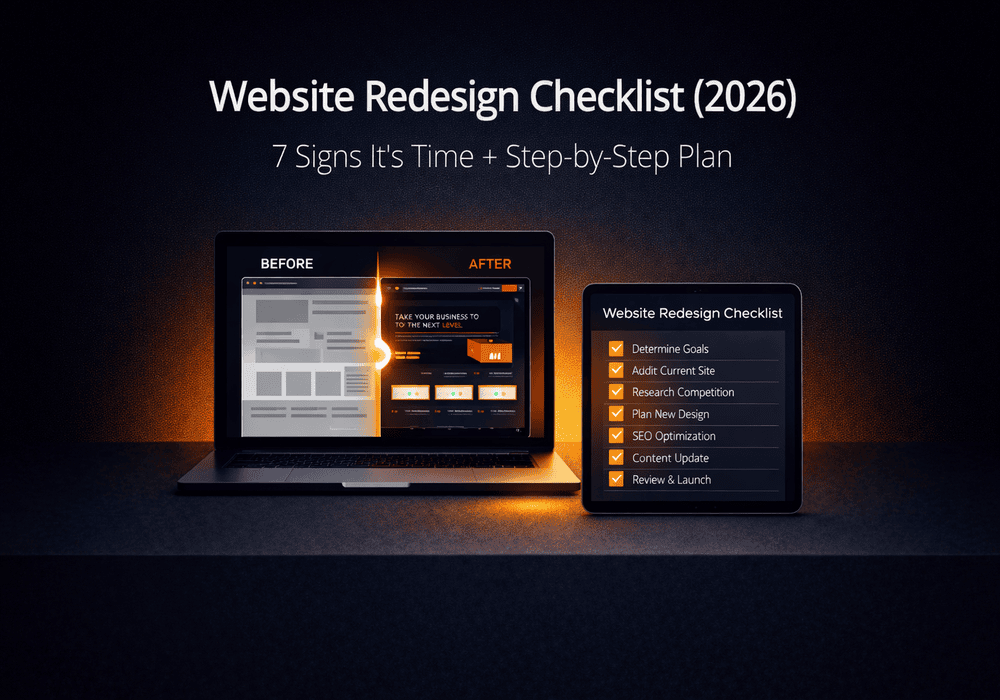
A website redesign isn’t just about making things look better. For most Knoxville businesses, a redesign becomes necessary for one of three reasons:
- Your site isn’t getting traffic
- Your site gets traffic but doesn’t convert
- Your site is outdated, slow, or hard to update
If you’re feeling stuck—no calls, no leads, low rankings—this guide will help you figure out whether you need a full redesign or just a strategic tune-up. You’ll also get a practical, phase-by-phase checklist you can follow from strategy all the way through launch.
And if you’re not sure where your site stands right now, a
And if you’re not sure where your site stands right now, a free website and SEO audit is the fastest way to get a clear picture before you commit to anything.
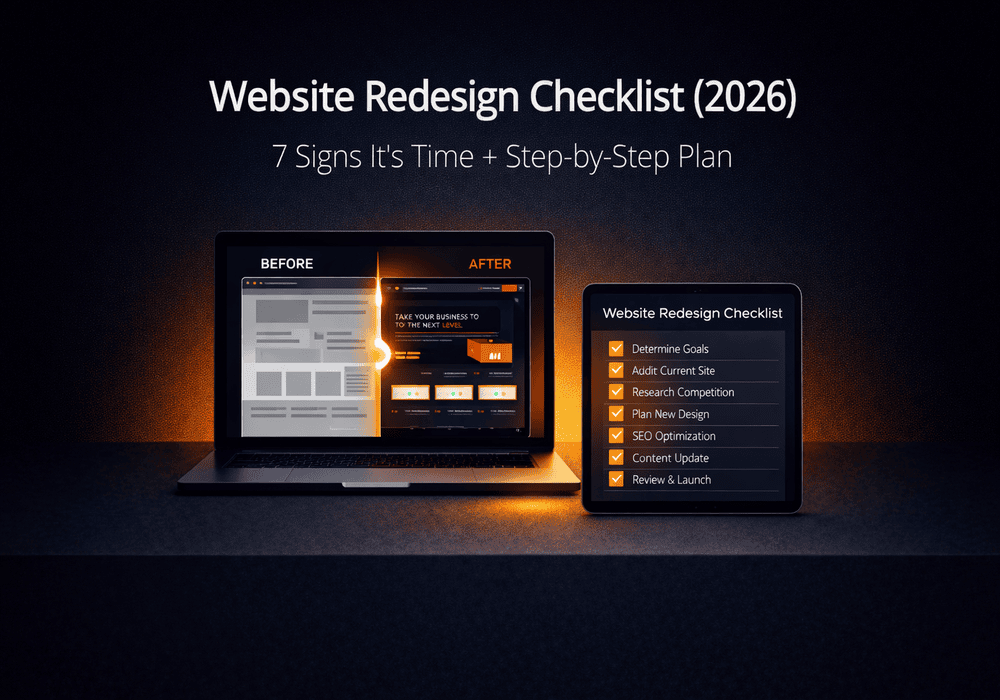
The 7 Signs It’s Time to Redesign Your Website
1. Your Website Looks Outdated (and People Bounce)
First impressions happen in milliseconds. If your site looks like it hasn’t been touched in years, visitors assume your business is behind—no matter how good your service actually is. In a competitive market like Knoxville, that snap judgment can send a prospect straight to a competitor.
Redesign signal: High bounce rate, low time on page, and low conversions—even when you’re getting traffic.
2. Your Site Is Slow (Especially on Mobile)
Page speed is a Google ranking factor. A slow site doesn’t just frustrate visitors—it actively hurts your SEO. Common culprits include:
- Unoptimized images
- Bloated themes or page builders
- Too many plugins and third-party scripts
- Cheap or shared hosting with poor performance
Redesign signal: Pages feel sluggish on phones or take more than 2–3 seconds to load. Check your Core Web Vitals in Google Search Console for specifics.
3. You’re Not Ranking for Your Core Services
If you’re a Knoxville business and you don’t show up when people search for what you do, your site may be missing proper
If you’re a Knoxville business and you don’t show up when people search for what you do, your site may be missing proper SEO structure, content depth, or both. A common sign is when only your homepage ranks for everything—meaning Google doesn’t understand what specific services you offer.
Redesign signal: You can’t rank for service-specific keywords, or you only rank for branded terms.
4. Your Website Doesn’t Tell People What to Do Next
If visitors have to hunt for your phone number, contact form, service areas, or pricing—your website is losing leads every single day. Clear calls-to-action (CTAs) are foundational, not optional.
Redesign signal: You’re getting visits but not calls or form submissions.
5. Your Content Is Thin or Generic
“Quality service at an affordable price” doesn’t differentiate you from any other business in your category. Modern websites need:
- Clear positioning that speaks to a specific audience
- Detailed, individually-optimized service pages
- Proof sections (reviews, awards, case studies, before/after photos)
- FAQs that answer buyer questions and support local SEO
Redesign signal: Your service pages are short, vague, and interchangeable with a competitor’s.
6. Your Site Is Hard to Update
If updating your website feels like a nightmare, you’ll avoid it—and SEO growth requires consistent updates and fresh content over time. A site that you can’t edit yourself is a liability, not an asset.
Redesign signal: You rely on a developer for minor changes, or you avoid editing because it routinely breaks layouts.
7. Your Site Isn’t Tracking Results Properly
If you can’t answer basic questions about where your leads come from, which pages convert, or what keywords drive traffic—you’re flying blind. Every site should have GA4, Google Search Console, and conversion tracking in place from day one.
Redesign signal: No analytics, no Search Console, no form or call tracking. You have no idea what your website is actually doing for your business.
Redesign vs. Refresh: What Do You Actually Need?
Not every site needs a full redesign. Sometimes you need a strategic rebuild of key pieces rather than starting from scratch. Here’s a quick way to figure out which applies to you.
A Refresh May Be Enough If…
- Your site is structurally solid and pages are already indexed
- You rank for some keywords but need more content depth
- The design is acceptable but needs modernization
- You mostly need better CTAs, faster speed, and stronger copy
A Full Redesign Is Likely Needed If…
- Your site is slow and structurally messy
- It’s not mobile-friendly or fails Core Web Vitals
- Your SEO is broken (bad architecture, thin or duplicate pages)
- You’ve rebranded, changed services, or expanded to new markets
- Conversions are consistently poor across all traffic sources
Not sure which bucket you fall into?
Not sure which bucket you fall into? G Squared Studios offers a detailed website and SEO audit that will tell you exactly what’s holding your site back and what the most impactful next step is.
The Website Redesign Checklist (Step-by-Step)
Whether you’re doing this yourself or working with a
Whether you’re doing this yourself or working with a Knoxville web design agency, this phase-by-phase checklist will keep you from missing the steps that sink most redesigns.
Phase 1: Strategy (Before Design Starts)
- Define your primary goal (calls, form submissions, bookings, purchases)
- List your top revenue-generating services—prioritize what you sell most
- Identify your target service areas (Knoxville + surrounding cities if applicable)
- Review top competitors: what are they doing better than you?
- Map out which pages you need (full site architecture)
Pro tip: If the goal is traffic, you need a content strategy—not just new colors. Design without strategy is decoration.
Phase 2: Site Architecture (Your SEO Foundation)
- Create one dedicated page per core service—never lump services together
- Build a clear, simple navigation (users and Google both hate clutter)
- Plan your internal linking structure (blog posts → service pages → contact)
- Add local relevance: Knoxville hub page + supporting service area pages if needed
- Plan FAQs for each service page (great for SEO and buyer education)
This is where most redesigns fail. Agencies focus on design and completely ignore structure. Without proper architecture, even a beautiful site won’t rank.
Phase 3: Content + Copywriting (Your Conversion Engine)
- Rewrite service pages to match buyer intent, not just describe features
- Add trust proof: reviews, awards, results, and real project photos
- Add a “process” section: what happens after someone contacts you?
- Add pricing guidance where appropriate (even ranges build trust)
- Add strong CTAs above the fold and at natural decision points throughout each page
Phase 4: Design + UX (Make It Easy to Convert)
- Mobile-first layouts—most of your traffic is on phones
- Sticky header or prominent contact options visible at all times
- Clean typography with generous spacing (readability = trust)
- Fast, intuitive navigation with clear page hierarchy
- Accessibility basics: readable text, sufficient contrast, large tap targets
Phase 5: Technical Build (Speed + Tracking)
- Compress all images and use modern formats (WebP where supported)
- Optimize for Core Web Vitals (LCP, CLS, FID)
- Use a clean, logical URL structure
- Plan all 301 redirects before launch—this is critical
- Set up GA4 and Google Search Console
- Install conversion tracking for calls, forms, and bookings
If your site runs on WordPress, make sure you’re also optimizing at the platform level. Our guide on WordPress SEO for Knoxville businesses covers the technical settings most sites miss.
Phase 6: Launch (Don’t Lose Your Rankings)
This is the phase most businesses skip—and it can destroy your SEO if done wrong. A redesign that moves or removes pages without proper redirects can wipe out years of ranking progress overnight.
- Crawl your current site and export all existing URLs
- Create a complete 301 redirect map: old URLs → new URLs
- Preserve your top-performing pages, or carefully recreate them
- Check indexation after launch (no pages accidentally blocked)
- Submit your updated sitemap in Google Search Console
- Monitor rankings and organic traffic for at least 30 days post-launch
The 3 Biggest Redesign SEO Mistakes
Even well-intentioned redesigns can tank your rankings. Watch out for these three:
- Changing URLs without 301 redirects. Every page that moves without a redirect becomes a dead link. Google treats it as a new page with no authority, and any existing rankings evaporate.
- Removing pages that currently rank. Just because a page looks outdated doesn’t mean it isn’t quietly sending you traffic. Always audit before you delete.
- Launching without tracking or sitemap submission. If you don’t submit your sitemap and verify tracking before launch, you won’t catch problems until significant damage is already done.
A redesign should improve your SEO—not reset it. The difference between a good redesign and a damaging one is almost entirely in the launch execution.
Related Reading from the G Squared Studios Blog
If this post was helpful, these related resources from our Knoxville digital marketing blog go deeper on the topics covered here:
- Local SEO for Knoxville Businesses — Why Architecture Matters
- Knoxville Web Design Services — G Squared Studios
- WordPress Website Development — Knoxville
- Request a Free Website + SEO Audit
Ready to Find Out What’s Actually Holding Your Website Back?
If you’ve made it through this checklist and realize your site is missing more than a few of these pieces, you’re not alone—and it’s fixable.
G Squared Studios is a Knoxville-based web design and SEO agency with 20+ years of experience helping local businesses build websites that rank on Google and convert visitors into real leads. Every project is handled personally by the owner—no account managers, no outsourcing.
Request a Website + SEO Audit (Knoxville)
Talk to G Squared Studios about a redesign built for rankings + conversions